Mortgage and Lien ☎️ Foreclosure Process.
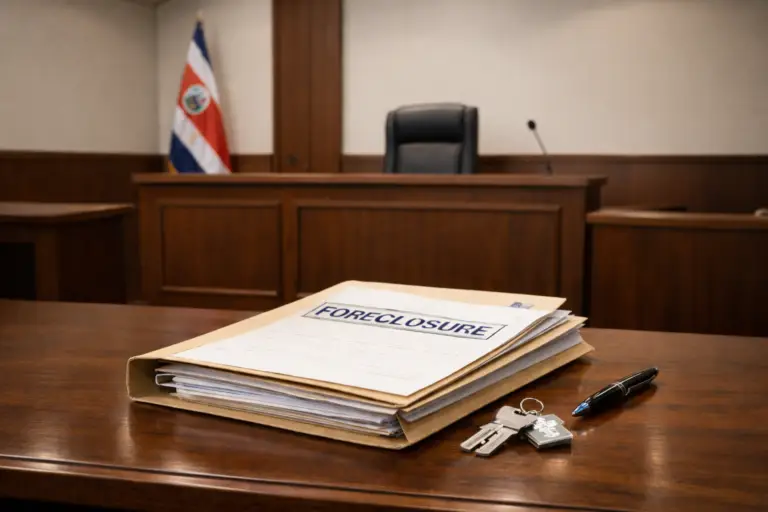
Mortgage and lien foreclosure in Costa Rica is governed by a special execution regime established by the Civil Procedural Code. This process applies exclusively to obligations secured by a duly registered mortgage or pledge and is designed to allow creditors to enforce their rights directly against the encumbered asset. Unlike ordinary civil lawsuits, foreclosure proceedings are strictly limited in scope and defenses, reflecting the privileged nature of real guarantees.
This page explains how the foreclosure process works, who must be sued, which defenses are allowed, and what happens when the collateral is enforced. It focuses on procedure, not on the civil-law definition of mortgages or liens.
Mortgage and lien enforcement as a special execution process
Under Costa Rican procedural law, registered mortgages and pledges constitute enforceable execution titles. This means that the creditor does not need to prove the existence or validity of the underlying obligation in an ordinary declaratory proceeding. The registered guarantee itself opens the enforcement route.
The foreclosure process is therefore a special execution proceeding, characterized by limited judicial review and accelerated enforcement. Its purpose is not to re-litigate the debt, but to make effective the legal privilege granted by the real guarantee. Learn more about mortgages and liens in Costa Rica.
Filing the foreclosure claim and the initial court order
Foreclosure begins with the filing of a judicial claim supported by the enforceable documents on which execution is based. These typically include certified copies of the registered mortgage or pledge, or the original mortgage bond instruments when applicable.
The claim must be directed against the debtor and against the owner of the encumbered asset if that person is different. Proper standing is essential. If the claim omits a required party, the court will order the claimant to correct the defect within a short statutory period. Failure to do so results in dismissal.
Once the claim is admitted, the court orders the registration of the foreclosure action in the corresponding public registry. This annotation automatically affects subsequent creditors or encumbrancers, who are not individually notified.
Who must be sued and why standing matters
In mortgage and lien foreclosure, standing is not a mere formality. The debtor must always be sued, as well as any third party who consented to the encumbrance over the asset. When personal guarantees exist and a deficiency balance may arise, guarantors may also be included in the proceeding.
Because foreclosure directly affects property rights, improper identification of the parties can delay enforcement or render the process ineffective. This is one of the most common procedural mistakes in foreclosure litigation.
Limited defenses in mortgage and lien foreclosure
One of the defining features of foreclosure proceedings is the narrow scope of admissible defenses. The debtor may only oppose enforcement on three grounds: lack of enforceability, payment, or statute of limitations. No other defenses are allowed.
Opposition must be filed within five days and is resolved through an incidental proceeding. The enforcement process itself does not stop, although final approval of enforcement measures will not occur until the opposition is resolved.
This limitation reflects the nature of foreclosure as an execution process rather than a full adversarial trial.
Deterioration or loss of the collateral
If it is proven during the proceeding that the collateral has deteriorated or that the guarantee has been extinguished, the creditor may pursue other assets within the same process. This mechanism prevents the foreclosure proceeding from becoming ineffective due to changes affecting the encumbered property or movable asset.
Deficiency balance and further collection
When the real guarantee is enforced and does not fully satisfy the debt, the court may establish a deficiency balance at the creditor’s request. Once that determination becomes final, additional assets may be pursued within the same proceeding.
Creditors holding lower-ranking guarantees who remain unpaid may also assert their claims in the same case, through separate procedural files. In certain circumstances, unpaid creditors may request the opening of insolvency proceedings, which are then transferred to the competent court.
Relationship with judicial auctions and general execution rules
Foreclosure proceedings lead to enforcement of the collateral through judicial mechanisms governed by general execution rules. While the sale of the encumbered asset is an essential step in enforcement, the detailed rules governing judicial auctions apply across multiple types of civil executions and are regulated separately.
Learn more about judicial auctions in Costa Rica.
Foreclosure and insolvency proceedings
Mortgage and lien foreclosure may intersect with insolvency proceedings when enforcement does not fully satisfy the debt or when multiple creditors remain unpaid. In such cases, Costa Rican law provides procedural coordination mechanisms to ensure orderly treatment of claims while respecting the priority of real guarantees.
Legal representation in foreclosure proceedings
Mortgage and lien foreclosure requires precise procedural handling. Errors in standing, documentation, timing, or opposition strategy can compromise otherwise valid claims. At CPG Legal, we represent creditors and debtors in foreclosure proceedings throughout Costa Rica. We combine both substantive knowledge of real guarantees with in-depth experience in civil procedure and litigation.